

Robotics Competitions in India: WRO, FLL, Technoxian and How to Prepare
A parent's guide to robotics competitions in India: WRO, FIRST LEGO League, Technoxian and more, who can enter, how they work and a 12-week plan to prepare.
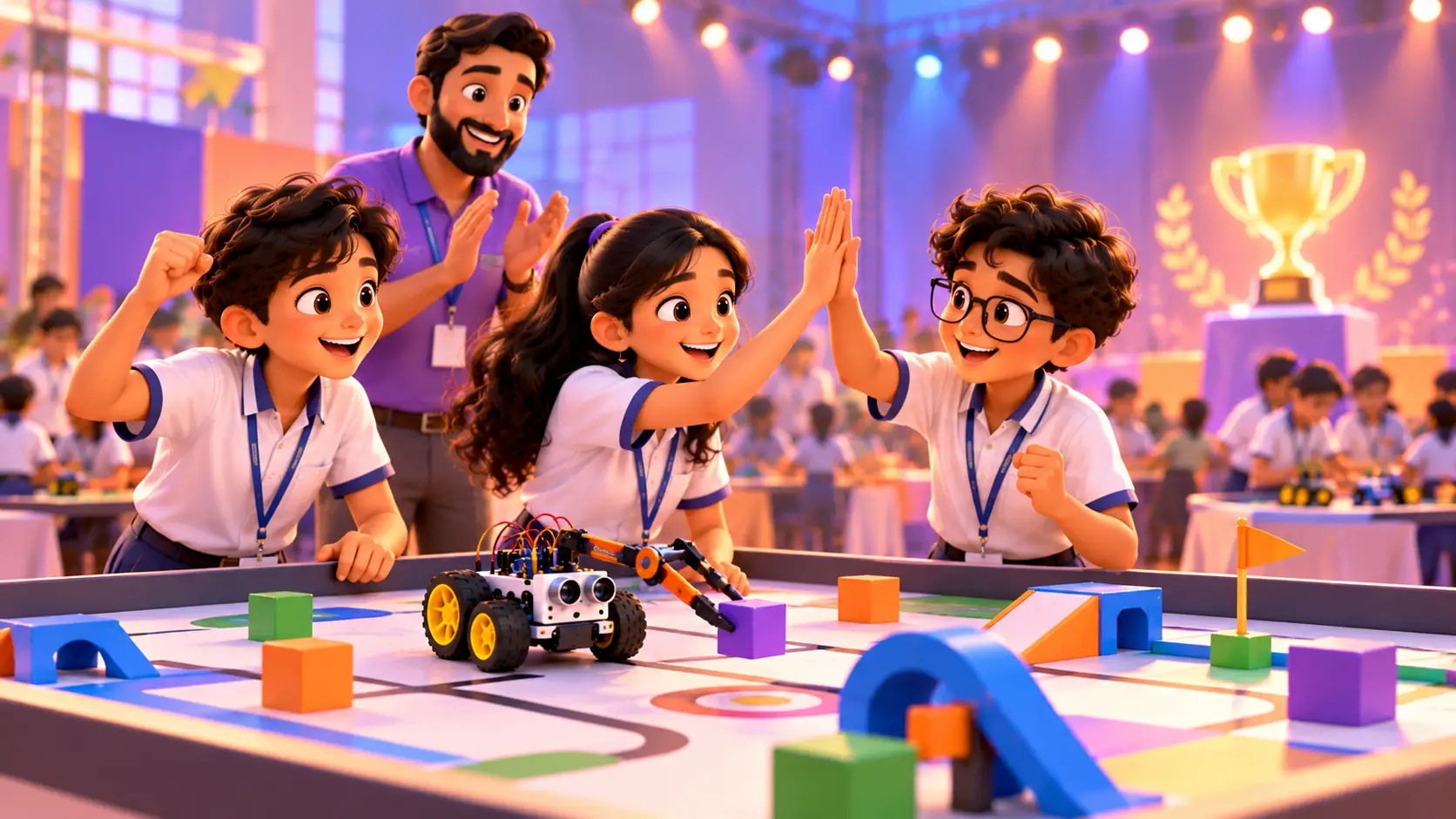
Robotics competitions turn learning into a real challenge, with a deadline, a team and a crowd. For many kids, it is the moment robotics stops being a class and becomes a passion.
This guide explains the main robotics competitions open to school students in India, who can enter, how they work, and a simple 12-week plan to prepare.
Why robotics competitions are worth it
- A real goal. Kids learn faster when there is a mission to complete.
- Teamwork. Building, coding and presenting are shared jobs.
- Problem solving under pressure. Robots rarely work perfectly the first time.
- Confidence. Explaining a robot to judges is a skill for life.
- Something to show. Competition experience stands out in school and college applications.
“Thanks to RoboticSchools for their brilliant guidance and support that helped my son build the confidence and capability to participate and win in a recent robotics competition.”
Abhishek Rajan, parent (Google review)
The main competitions compared
Rules, age bands and dates change every year, so always confirm on the official website before registering.
| Competition | Typical ages | Format | Robot |
|---|---|---|---|
| World Robot Olympiad (WRO) India | about 8 to 19 | Teams of 2 to 3 with a coach; regional, national and international rounds | Often LEGO-based, depending on the category |
| FIRST LEGO League (FLL) | about 9 to 16 | Teams with a coach; robot game, innovation project and team values | LEGO robots |
| Technoxian | School and college levels | Many categories, like robot racing and soccer | Depends on category |
| Robotex India | School and college levels | Several challenge categories | Depends on category |
| e-Yantra (IIT Bombay) | Mostly older students | Project-based robotics challenges | Varies |
World Robot Olympiad (WRO)
WRO is one of the largest international robotics competitions. Categories include RoboMission, where robots complete tasks on a mat, and creative categories where teams design a robot to solve a real problem. Students must build and program the robot themselves. Coaches guide, but do not build. Teams move from regional rounds to the national final, and the best go to the international event. Details: wroindia.org.
FIRST LEGO League (FLL)
FLL combines a robot game on a themed mat with an innovation project, where the team researches a real-world problem, and is judged on teamwork and values too. It is a great first competition because it rewards more than just the robot.
Technoxian and Robotex India
These run many categories, from racing robots to robot soccer and maze solving. Some allow open hardware like Arduino, which suits kids who learn electronics and coding outside LEGO kits.
Which competition suits your kid?
- Ages 8 to 12, new to competitions: FLL or an entry WRO category. Both are beginner-friendly and team-based.
- Kids who love coding and precise missions: WRO RoboMission.
- Kids who love inventing: creative or innovation categories, where the idea matters as much as the robot.
- Teens comfortable with Arduino and sensors: open-hardware categories at Technoxian or Robotex.
A 12-week preparation plan
| Weeks | Focus |
|---|---|
| 1 to 2 | Read the rules together. Form the team, pick roles and set a practice schedule. |
| 3 to 5 | Learn the core skills: driving straight, turning accurately, reading sensors, following a line. |
| 6 to 8 | Build the competition robot and solve one mission at a time. |
| 9 to 10 | Run full practice rounds with a timer. Write down what fails, and fix it. |
| 11 | Make the robot reliable: check battery levels, tighten parts, simplify risky moves. |
| 12 | Practise explaining the robot and the code to “judges” (parents and friends). |
Core skills judges and missions test
- Accurate movement: going straight and turning exact angles
- Sensors: following lines, detecting colours and measuring distance
- Reliable code: the same result every run, not just once
- Debugging: finding why something failed and fixing it fast
- Teamwork and explanation: every member can explain the design
How to split roles in a team
Most competition teams have two or three members. Every member should understand the whole robot, but giving each person a main role keeps practice organised:
- Builder: designs and builds the robot, and keeps it strong and reliable.
- Programmer: writes and tests the code for each mission.
- Strategist and presenter: plans which missions to try in what order, times the runs and leads the explanation to judges.
Swap roles during practice now and then. Judges often ask any member any question, and the team is stronger when everyone can step in.
A practice mission, step by step
Imagine a mission: the robot must leave the start area, follow a line to a coloured block and push it into a target zone.
- Break it into small moves: leave the base, find the line, follow it, stop at the block, push, return.
- Solve one move at a time, testing each part before adding the next.
- Measure, do not guess: record how many degrees each turn needs, and use sensors instead of timing where you can.
- Run it ten times. If it works seven out of ten, find out why the other three failed.
- Time the full run, because in the real round every second counts.
Practising like this teaches the habits that win competitions: patience, careful testing and clear thinking.
What does a competition cost?
Costs vary by competition and city, so check each official site. Plan for:
- Registration fees for the team
- The robot kit, especially if the competition requires a specific kit
- Practice materials, such as a printed mission mat and spare parts
- Travel and stay for national or international rounds
- Coaching or classes to build the skills, if your kid needs them
Many families share costs across the team, and some schools sponsor teams. Ask your school before you buy anything.
What a competition day looks like
- Arrival and check-in. Teams set up at their tables and check the robot.
- Practice time. Some competitions allow a short practice run on the real table.
- Rounds. Robots run the missions, usually two or three times, with the best score counted.
- Judging. Teams explain their robot, their code and what they learned.
- Results. Winners may move on to the next level.
Robots that worked perfectly at home sometimes fail on the day, because of different lighting, a slightly different table or nerves. Teams that practised in different conditions handle this best.
What parents should (and should not) do
Do:
- Help with schedules, travel and registration deadlines
- Encourage the team when things go wrong
- Ask questions that make them think: “Why did it turn too far?”
Do not:
- Build or code the robot for them (it is against the rules and kids learn nothing)
- Focus only on winning
- Compare your kid with other teams
What judges look for
- Did the students build and program it themselves?
- Can each member explain how it works?
- Is the robot reliable, not just lucky?
- How did the team solve problems along the way?
- Did they work well together?
Common mistakes to avoid
- Starting too late. Robots always need more testing than expected.
- Overcomplicated designs. Simple, reliable robots usually score more.
- Not reading the rules. Teams lose points for things that were clearly written down.
- Only practising perfect conditions. Test with different lighting and battery levels.
Building the skills with RoboticSchools
Our robotics courses build exactly the skills competitions test: building, wiring, sensors, motors, coding and debugging.
- Micro:bit Robotics (ages 7 to 11): first robot cars and line following
- Arduino Robotics (ages 10 to 15): 75 live classes and 52 projects with real sensors and motors
- ESP32 IoT Robotics (ages 12 to 18): phone-controlled and connected robots
Classes are live and 1-on-1, so the trainer can focus on your kid’s robot and code. Kits are shipped to your home. Read robotics for kids: what they learn and our robotics kits buying guide.
Start building competition skills
In a free demo class, a trainer works with your kid, sees their level and suggests the right path towards competitions. Online or at our centre in Bellandur, Bangalore.

 Chat on WhatsApp